
In Greece, they use Type C and F power plugs and outlets. The voltage is 230V, and the frequency is 50Hz.
⚠️ So, you’ll need a travel adapter in Greece. Their plugs and outlets are different from the Type A and B ones we use back in the States.
Quick Overview of the Plugs in Greece:
- Plug type in Greece: C and F
- Standard voltage: 230V
- Frequency: 50Hz
- Need a travel adapter? Yes, you do need a travel adapter
- Need a voltage converter? Some devices need it, others don’t
- Recommended plug adapter: One Beat International Power Adapter
The information you see here is carefully compiled from official power authority guidelines, global IEC standards, and real traveler feedback from around the world.
Power Outlets in Greece
In Greece, they use Type C and F power plugs and outlets.
Type C

Type C outlets have two round prongs and no grounding pin. Type E and F plugs usually fit too, but grounded plugs will need an adapter.
Type F

Type F outlets have two round prongs and grounding clips on the sides. Type C and E plugs will also fit.
The Only Travel Adapter You’ll Need in Greece
Need a reliable travel adapter for Greece? We don’t sell them, but we’ve researched the best option based on voltage, safety, and plug types. Here’s what we recommend:
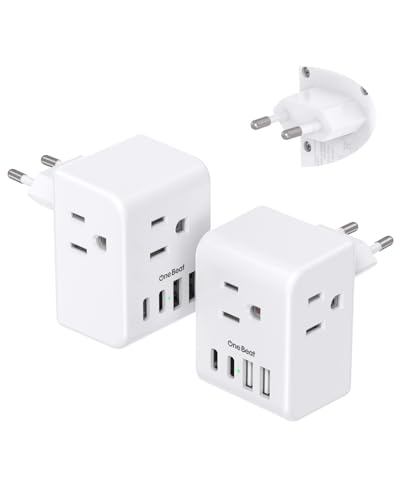
Forgot your power adapter and you’re already traveling? It’s not the end of the world—most airports and local stores sell them. But packing your own means you’re ready to go the moment you land, with no extra stops needed.
Travelers going through Greece often combine their trip with Turkey, Albania, and North Macedonia. Be sure to check which plug types you’ll need.
Do You Need a Voltage Converter?
A voltage converter is likely needed in Greece because your device must match the country’s voltage. The U.S. runs on 120V, but Greece uses a different voltage, so a converter is necessary.
Always double-check the label on your electronics before traveling abroad. If you see “100-240V, 50/60 Hz”, your device is built for global use and doesn’t require a converter. This applies to most smartphones, laptops, cameras, and rechargeable devices.

Which Travel Devices May Need a Converter?
Don’t want to guess which converter works? Here are the best-reviewed ones worth checking out.
| Device | Need Converter? | Notes |
|---|---|---|
| Phone | ❌ No (usually) | Most modern phone chargers are dual voltage (100–240V) |
| Laptop | ❌ No (usually) | Check the power brick label for 100–240V |
| Hairdryer | ✅ Yes (often) | High wattage; many models are not dual voltage |
| Electric toothbrush | ⚠️ Check voltage | Some models are 110V only |
| Camera / DSLR | ❌ No (usually) | Most chargers are dual voltage |
| Power bank | ❌ No | Charges via USB, adapter is enough |
| Electric shaver / trimmer | ⚠️ Check voltage | Older or cheaper models may not support 230V |
| Tablet / iPad | ❌ No | All models are dual voltage |
| Portable fan | ✅ Yes (sometimes) | Many models are not compatible with 230V |
| Game console | ⚠️ Check voltage | Newer consoles like PS5 and Xbox are often dual voltage — check to be sure |
| Bluetooth speaker | ❌ No (usually) | Charges via USB |
| E-reader (Kindle, etc.) | ❌ No | USB charging only, no converter needed |